I
Foundation in Craft
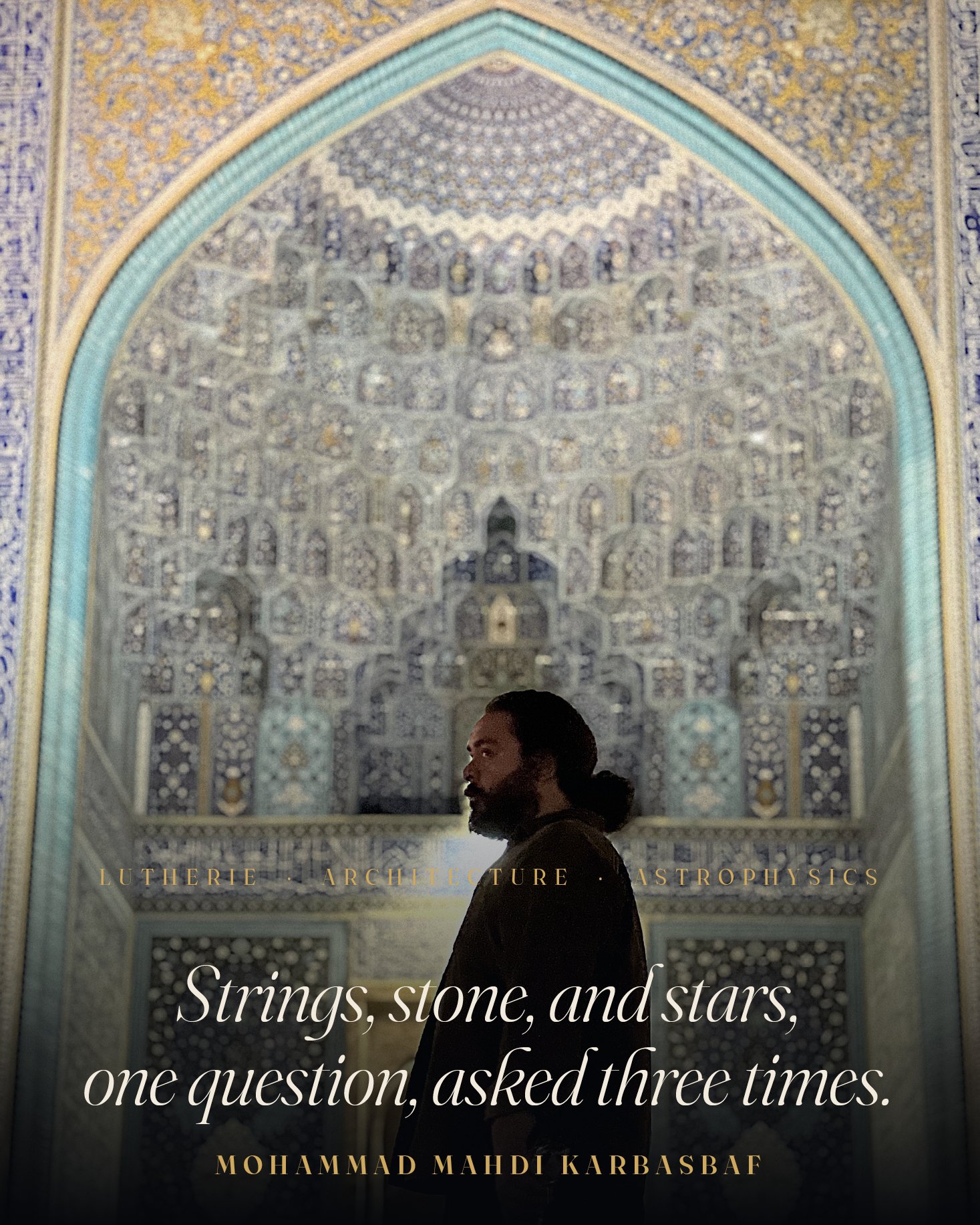
The work begins with a question asked twice, once on paper, once with the hands. A mechanical engineering thesis on opera halls as acoustic resonators, gave the question its first formal shape. Its more lasting answer came from the workbench: from 2015 onward, hands-on contact with stringed instruments, investigating, building, and repairing traditional Persian lutes, meant learning first through the hands, and only later through measurement: why one soundhole speaks and another sits mute, why a maker's inherited instinct for proportion so often lands exactly where the physics would have predicted, if anyone had thought to ask the question first.
That inherited instinct became, from 2015 onward, the starting point for the Golden Method, an attempt to make explicit the acoustic wisdom already embedded, wordlessly, in centuries of craftsmanship, and to give soundhole design a geometry that could be taught rather than only inherited. The instrument stayed the same. What changed was the willingness to ask a craft tradition to explain itself in the language of resonance.
II
Expansion of Wave Analysis
The same question, where does a wave decide to speak? turned out not to belong to instruments alone. Extending that acoustic lens to Persian architectural heritage revealed wave-analysis principles quietly operating within structural ornamental elements long assumed to be purely decorative: the tong bori, the muqarnas vault, the perforated lattice, each one behaving, under analysis, less like ornament and more like an instrument that had simply never been asked to perform.
Current research follows that same principle further outward still, toward electromagnetic and plasma wave phenomena in astrophysical and nebular environments, where resonance operates at a scale no workbench could ever hold, but where the underlying question hasn't changed at all: given a cavity, a boundary, a medium capable of oscillation, what shape does the wave ask to be given, and what is listening for the answer.
Alongside the research, a parallel line of craft has continued undisturbed: Thuluth calligraphy, practiced to a professional standard, and, more recently, the redesign of book covers for canonical works of literature and philosophy. Different medium, same instinct, an attention to proportion, restraint, and the exact weight a form is asked to carry.